Color Guard Graphics: Crafts-Ready SVG, EPS, DXF & PNG Cut File
As a brand designer who’s developed visual identities for over 30 local businesses—from heritage bakeries and botanical skincare studios to handmade candle boutiques and seasonal gift shops—I recently evaluated Color Guard Svg, Eps, Dxf, Png, Cut File for use in a real-world branding project: a small-batch lavender honey brand launching at farmers’ markets and indie retail shelves.
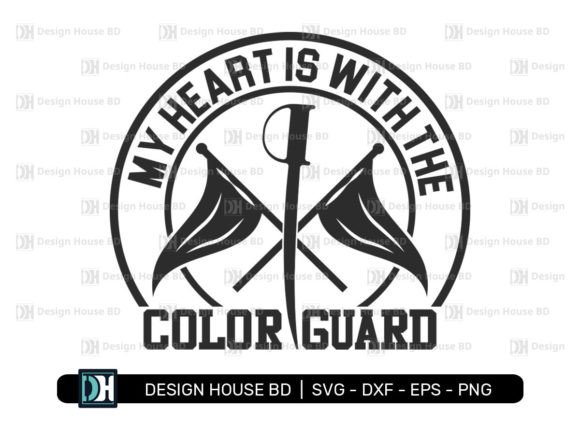
First impression? It reads as bold, rhythmic, and celebratory—less “military precision” and more “festive procession.” The linework carries confident weight, with balanced negative space and intentional flourishes that suggest craftsmanship without feeling overly ornate. It leans into warmth and movement, making it ideal for brands that want to feel artisanal, joyful, and grounded—not sterile or corporate. Think: a floral apothecary’s holiday packaging, a children’s toy shop’s summer sale banner, or a coffee roaster’s limited-edition bag accent. It’s not minimalist, but it’s not chaotic either—it lands cleanly in the expressive middle ground where handmade business branding thrives.
Where This Graphic Design Asset Earns Its Keep in Real Local Business Work
Color Guard Svg, Eps, Dxf, Png, Cut File isn’t just another clipart download—it’s a versatile design asset that delivers measurable value across touchpoints. In our lavender honey project, we used it as a wrap-around border on product labels (SVG + EPS), a foil-stamped motif on rigid kraft boxes (vector-editable EPS), and a scaled-down watermark on thank-you cards and social media story highlights (PNG with alpha transparency). Because You will get the following file formats—SVG for web and scalable vector use, PNG for quick digital placement, DXF for vinyl cutting and CNC routing, and EPS for legacy print workflows—we avoided last-minute format swaps or pixelation surprises.
It strengthened shelf appeal instantly: on matte-finish honey jars, the clean vector lines popped against earthy tones while maintaining legibility at 1.5 inches tall. As a decorative brand element, it created visual hierarchy—guiding the eye from logo to flavor name to certification badge without competing for attention. For the owner’s Instagram feed, we repurposed the same SVG to build cohesive carousel graphics, reinforcing brand recognition across posts, reels, and highlight covers.
Smart Uses That Build Trust & Polish
- Product labels & hang tags: Works beautifully as a frame, corner accent, or repeating pattern—adding craft credibility without overwhelming ingredient lists or certifications.
- Packaging design: Scales cleanly for box wraps, sticker seals, and belly bands—especially effective when paired with uncoated paper stocks or textured labels.
- Social media graphics: The PNG version holds up crisply in Canva templates; the SVG allows smooth animation in web banners or email headers.
- Seasonal campaign visuals: Easily recolored to match spring pastels, autumn rusts, or winter metallics—ideal for limited-run packaging or market booth backdrops.
- Printable design assets: Used as a subtle background texture in printable recipe cards and loyalty program inserts—adds cohesion without sacrificing readability.
Where to Proceed Thoughtfully
This graphic design asset shines brightest when it supports—not defines—the brand identity. Avoid using it as a primary logo (it lacks typographic integration and standalone memorability), and steer clear of dense layouts where fine details could blur—like crowded food labels with tight regulatory text or tiny QR-code stickers. It’s also less suited for luxury minimalist brands (e.g., high-end ceramics or Scandinavian skincare) where restraint is core to the positioning. And never place it directly over low-contrast backgrounds—test your PNG transparency layer first, especially if overlaying photos or gradients.
Practical Brand Designer Notes for Small Business Owners
Before committing to Color Guard Svg, Eps, Dxf, Png, Cut File in your next project, run these checks:
- Test it on a real product mockup—print a 2” label sample to verify line clarity and spacing.
- Convert to grayscale and preview on black-and-white packaging—does it retain impact?
- Place it beside your brand fonts: Does it harmonize with your serif body copy? Your handwritten tagline? Your bold sans-serif menu headers?
- Open the SVG in Illustrator or Affinity Designer—confirm paths are clean, grouped logically, and editable (no embedded raster elements).
- Check the PNG’s transparency edge—no halos or anti-aliasing artifacts that’ll muddy on dark backgrounds.
- Verify commercial license coverage—this is essential for client work, physical product sales, and any resale context.
- Compare side-by-side with competitor packaging—is it distinctive enough to stand out at a glance?
For small business branding, consistency compounds. Every time a customer sees that same confident motif on a jar, a receipt stamp, a story highlight, or a market tent banner, it quietly reinforces reliability and care. Color Guard Svg, Eps, Dxf, Png, Cut File delivers that continuity—not as a full brand system, but as a reliable, production-ready piece of the puzzle. It’s the kind of graphic design asset that helps handmade businesses look intentionally designed, not pieced together. And in local markets where first impressions happen in under three seconds, that polish isn’t optional—it’s foundational.
You’ll get all formats in one zip file—SVG for flexibility, PNG for speed, DXF for makers, EPS for printers—and yes, you can resize it freely without degradation. But the real value isn’t just technical versatility. It’s how this single design asset helps local business owners present their work with the confidence, clarity, and craft it deserves.